 Guardian Reader
The second version is easier to live with, because the child is no longer arguing with you. They are deciding whether they want the screen enough to pay for it. Most days, they do, and the reading happens.

Why earned beats given
Something handed over freely gets treated as a baseline, and any reduction feels like a punishment. Something earned gets treated as a reward, and the same amount of screen time suddenly feels generous.
Nothing about the screen time changed. Only its status did. That is the whole trick, and it is why this framing survives where 'you get two hours' quietly becomes 'why only two hours'.
Setting the exchange rate
The rate has to be winnable on a bad day. If a tired eight-year-old cannot complete it on a Tuesday night, the system breaks and you go back to arguing.
Reasonable starting points, adjusted after a week of watching how it actually goes:
- Ages 4 to 6: one page, about 5 minutes, unlocks 15 minutes.
- Ages 7 to 9: two pages, about 10 minutes, unlocks 30 minutes.
- Ages 10 to 12: three pages, about 15 minutes, unlocks 30 to 45 minutes.
- Teens: four or more pages, about 20 minutes, unlocks 45 minutes.
The part everyone underestimates: verification
Every reward system dies at the same point, which is the moment the child learns that saying "I read it" is enough. Once claiming is as good as doing, the system is a formality and both of you know it.
Paper charts and honour-system apps have this hole. So do apps that only ask a comprehension question afterwards, because a quiz about a page can often be guessed, skimmed or answered from the pictures.
The fix is to verify the reading itself, not the claim about it and not a memory of it.
Rules that hold up
Three properties separate a rule that survives from one that quietly dies:
- It applies every day, including the days you are exhausted and would rather not enforce anything.
- It does not depend on you being in the room, or on trusting an unverifiable claim.
- It is the same rule tomorrow. Renegotiating once teaches your child that the rule is negotiable.
Mistakes to avoid
- Making the daily target so big that failing is normal. Failure has to be rare or the habit never forms.
- Adding chores, homework and reading into one points system. It muddies the message; keep reading its own currency.
- Using screen time as a punishment as well as a reward. If it can be taken away arbitrarily, earning it stops meaning anything.
- Changing the rate as a bargaining chip. The stability is the feature.
How Guardian Reader enforces it
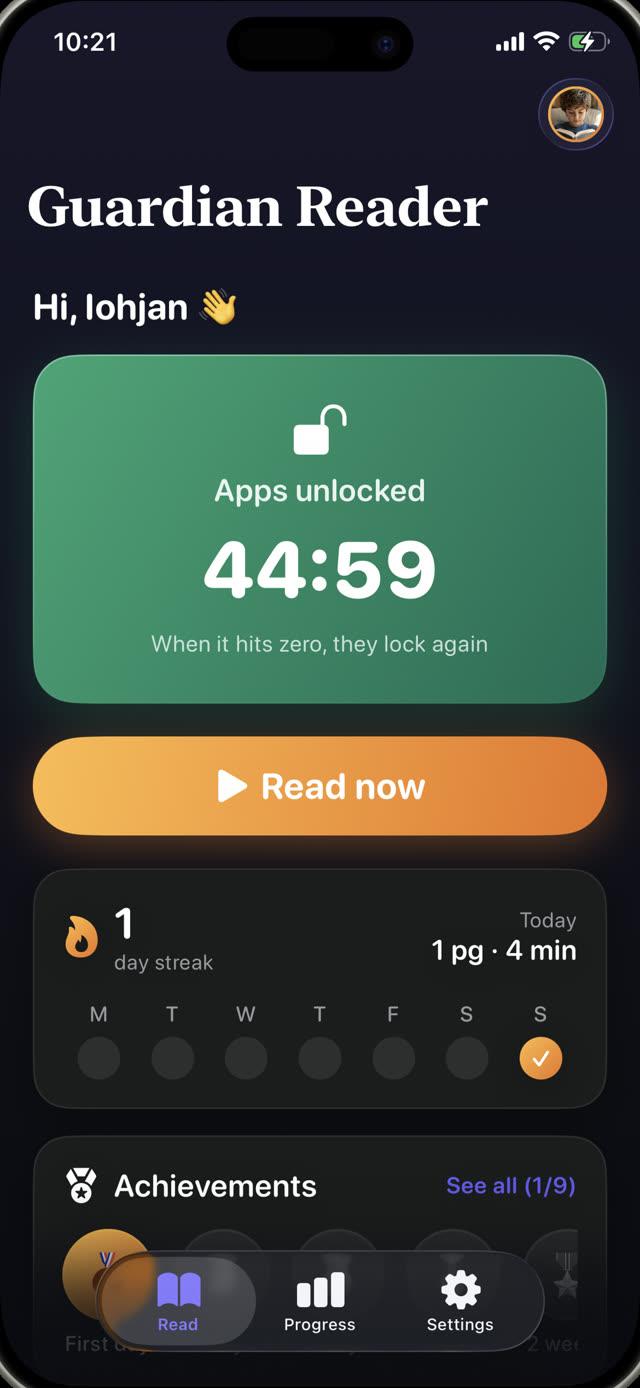
Guardian Reader is built around exactly this exchange. You pick the apps to lock, the pages per session and the minutes earned; your child photographs the pages of a real book, one photo per page, and reads them all out loud in one go.
The app matches what it hears against the scanned text, word by word. Reading it honestly passes comfortably. Improvising, mumbling or playing a video does not, and a page already scanned in that session cannot be scanned again. When the earned minutes run out, the apps lock themselves again, even if the app is closed.
Reading unlocks the screen.
Free to download · No accounts, no tracking
Get Guardian Reader for iPhone