 Guardian Reader
So the useful question is not how to convince your child that reading is good for them. It is how to change the conditions so that reading actually happens. Here are seven things that work, roughly in order of how much difference they make.

1. Shrink the ask until it is almost embarrassing
Ten minutes. Or one page. A goal that small removes the argument, because there is no honest way to claim it is too much. Consistency is what builds a reader, and consistency is far easier to get from a tiny daily ask than from a heroic weekend one.
Once the habit is real, the number grows on its own. Children who read every day almost always end up reading past the timer, because stopping mid-story is unnatural. The timer exists to get them started, not to limit them.
2. Let them choose what counts as a book
Comics count. Graphic novels count. Football almanacs, joke books, Minecraft guides and magazines count. A child who reads what they chose is practising the same decoding, vocabulary and fluency as a child reading a prize-winner, and they are practising it willingly.
The book that gets read beats the book you wish they would read. You can steer the taste later, once reading itself is not the fight.
3. Make the book physically closer than the phone
Friction decides most behaviour. If the phone is in their hand and the book is on a shelf in another room, the phone wins before anyone has made a decision. Put two or three books where the evening actually happens: the kitchen table, the couch arm, the bed.
The same logic works in reverse. Anything that adds ten seconds of friction to opening an app buys the book a chance.
4. Keep reading aloud past the age it feels necessary
Reading to a child who can already read is not babying them. Their listening comprehension runs years ahead of their reading level, so being read to is where they meet the vocabulary and sentence structure they cannot yet decode alone.
The reverse matters too: having your child read aloud to you is the single most effective fluency exercise there is, and it is the one teachers ask for at home. Ten minutes, out loud, most days.
5. Make reading the price of the screen, not its enemy
Framing screen time as a reward for reading changes the entire dynamic. You stop being the person taking something away and become the person holding the door. The child is not being punished; they are paying an entry fee they can afford.
The catch is enforcement. A verbal deal collapses the first evening you are tired, and "I already read" is impossible to check when you were making dinner. The rule has to hold without you having to be the referee every night.
6. Let them see the streak
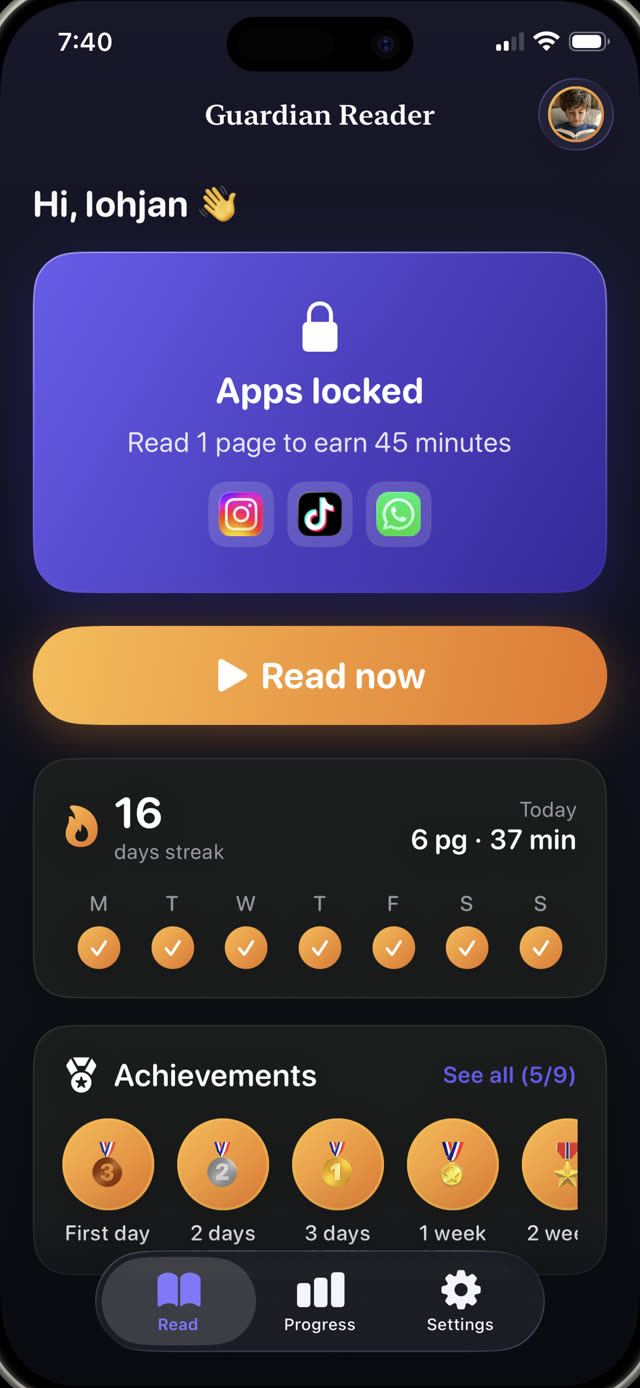
Children respond to visible chains far more than to praise. A row of days, a medal at seven days, a number that goes up: these carry a habit through the weeks when motivation is gone.
It works because it moves the reason to read from you to them. Nobody wants to break a streak they built.
7. Stop grading the reading
If every session ends with questions designed to catch them out, reading becomes a test, and nobody volunteers for a test. Ask what happened in the story the way you would ask about a film. Curiosity is contagious; interrogation is not.
Where Guardian Reader fits
Guardian Reader turns points 5 and 6 into something that runs by itself. You choose which apps stay locked and how much reading unlocks them. Your child photographs the pages of any physical book, reads them out loud straight through, and the app checks the reading against those pages before releasing the screen time.
You are not in the loop, which is the point. No negotiation, no trusting a claim you cannot verify, and a streak your child keeps alive on their own.
Reading unlocks the screen.
Free to download · No accounts, no tracking
Get Guardian Reader for iPhone