 Fix Your Life
You're on autopilot more than you think
Psychologists estimate that our minds wander for a huge share of our waking hours — by some research, close to half the day. You drive somewhere and remember nothing about the trip. You scroll for "a minute" and lose forty. You answer "how are you?" without checking whether it's true.
Autopilot isn't a character flaw. It's your brain saving energy by running familiar routines without conscious input. The problem is that your goals — the life you say you want — live in the conscious part. When you spend the day in routine-mode, weeks pass and nothing you actually care about moves.
Why "just be more mindful" never works
The advice to "be more present" fails for a simple reason: noticing you're on autopilot requires not being on autopilot. You can't remember to wake up while you're asleep at the wheel. Intentions don't fire on their own — something external has to fire them for you.
That's why every tradition that takes presence seriously uses interruptions. Monasteries ring bells. Muslims pause for prayer five times a day. The Stoics scheduled a morning preparation and an evening review. The mechanism is identical: a trigger you don't control breaks the trance, on a schedule.
The system: scheduled confrontations
Here's a practical version you can run with nothing but your phone:
- Pick 2–3 fixed moments a day. Good defaults: mid-morning (9:30), after lunch (1:00 PM), and before winding down (9:00 PM). These are the hours when drift is strongest.
- Attach a confronting question to each. Not a gentle chime — a question with an edge. "Are you doing everything necessary to achieve your goals?" "Are you spending time on things you truly want?" A bell you can ignore; a direct question demands a verdict.
- Answer in writing, in one line. This is the step everyone skips and the one that matters most. A mental "yeah, sure" changes nothing. Writing "No — I've been on Twitter for an hour" stings, and the sting is the point. That's awareness returning.
You can't steer a life you're not looking at. The question forces you to look.
What happens after two weeks
The first days, the interruptions feel jarring — proof of how deep the trance runs. Then something shifts: you start catching yourself drifting before the alarm asks. The scheduled question trains a reflex of self-checking, the same way a rear-view mirror trains you to glance without thinking. Your one-line answers become a record of where your days actually go — often the most honest document you own.
How to run this with Fix Your Life
Fix Your Life is an alarm app built exactly for this practice — a mindfulness reminder you can't swipe away:
- Set 2–3 alarms for your drift-prone hours. They ring until you face them — no snoozing back into the trance.
- Pick confronting questions from the presets, or write your own. Turn on Surprise mode to get a different question each day, so it never becomes background noise.
- Answer in one line. Every answer is saved to your Journal with its date and question, and your streak grows each day you show up.
- Add the home screen widget so the question of the day keeps working on you between alarms.
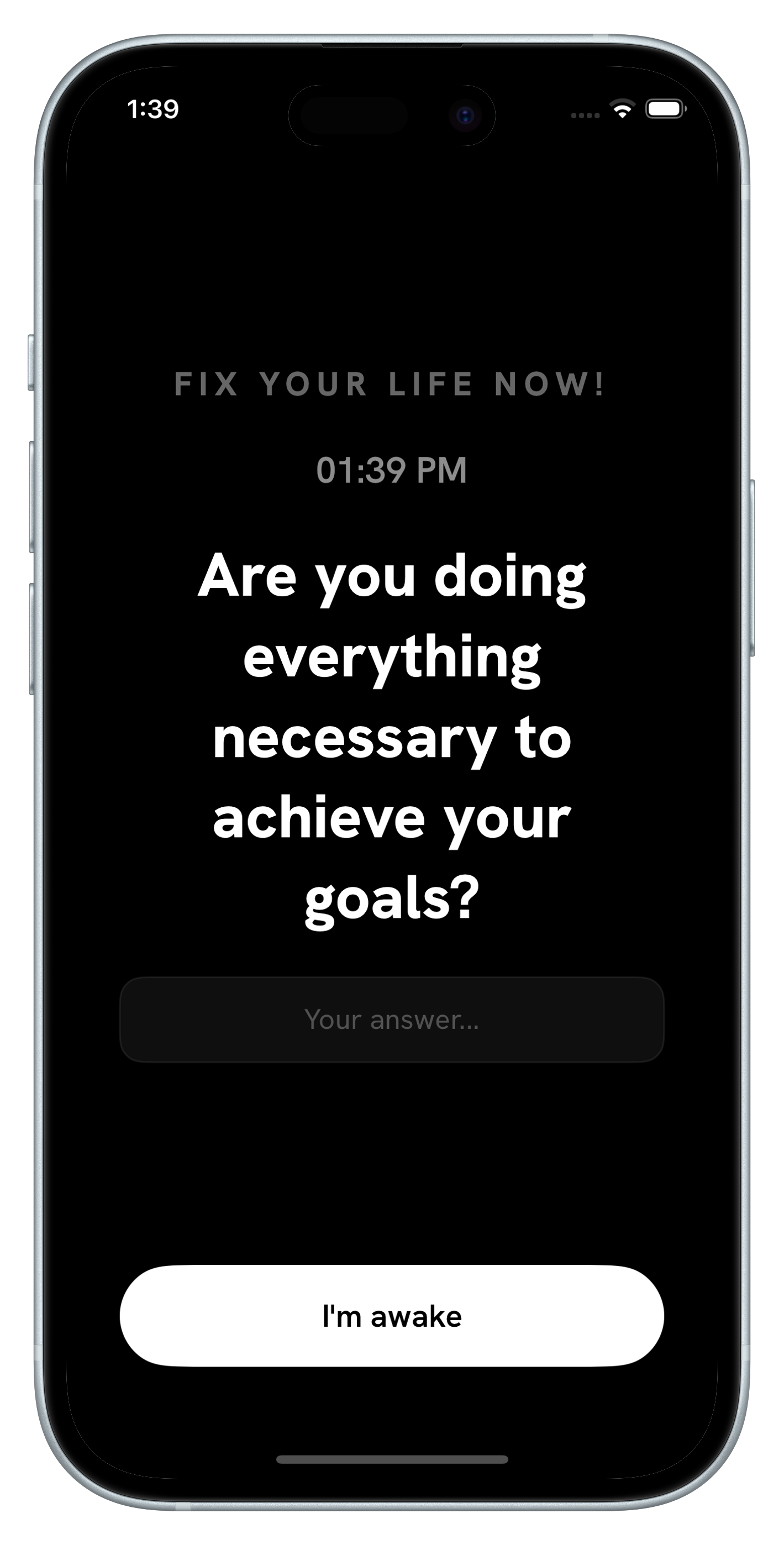
Wake up to the present moment.
Free to download · 3-day free trial · No ads. Ever.
Download Fix Your Life