 Trip Sort
Tile Match vs. Mahjong Solitaire: What's the Difference?Tile match vs. mahjong solitario: ¿cuál es la diferencia?
Mahjong solitaire and mahjong tile match are cousins, not twins. In classic mahjong solitaire you remove matching pairs of "free" tiles straight from a stacked layout; in a triple tile match game you tap tiles into a small tray and clear them in sets of three. Both reward the same habit of reading the layers, but the tray changes how you plan every move.El mahjong solitario y el mahjong tile match son primos, no gemelos. En el mahjong solitario clásico sacás pares de fichas "libres" directamente de una pila armada; en un juego de triple tile match tocás fichas que pasan a una bandeja chica y desaparecen de a tres. Los dos premian la misma costumbre de leer las capas, pero la bandeja cambia cómo planificás cada jugada.
How classic mahjong solitaire worksCómo funciona el mahjong solitario clásico
Mahjong solitaire borrows the tiles of the traditional four-player game of mahjong, but none of its rules. It first appeared as a computer game in the early 1980s and has been one of the most popular forms of tile solitaire ever since. The classic version works like this:El mahjong solitario toma prestadas las fichas del mahjong tradicional de cuatro jugadores, pero ninguna de sus reglas. Apareció por primera vez como juego de computadora a principios de los años ochenta y desde entonces es una de las formas más populares de solitario de fichas. La versión clásica funciona así:
- The set. A full set has 144 tiles: four copies each of 34 standard tiles (the dots, bamboo and characters suits, plus the winds and dragons), and eight bonus tiles, four flowers and four seasons.El juego de fichas. Un juego completo tiene 144 fichas: cuatro copias de cada una de las 34 fichas comunes (los palos de círculos, bambúes y caracteres, más los vientos y los dragones), y ocho fichas extra, cuatro flores y cuatro estaciones.
- The layout. All the tiles are stacked face up in a layered shape. The best known is the pyramid-like "turtle", but there are hundreds of layouts.La disposición. Todas las fichas se apilan boca arriba formando una figura con capas. La más conocida es la "tortuga", con forma de pirámide, pero hay cientos de disposiciones.
- Free tiles. A tile is free when no tile sits on top of it, even partly, and at least one of its long sides, left or right, is open. A tile wedged between neighbors on both sides is blocked.Fichas libres. Una ficha está libre cuando no tiene ninguna ficha encima, ni siquiera en parte, y al menos uno de sus lados largos, el izquierdo o el derecho, está despejado. Una ficha encajada entre vecinas por los dos lados está bloqueada.
- Pairs. You remove two identical free tiles at a time. The bonus tiles are the exception: any flower matches any flower, and any season matches any season.Pares. Sacás dos fichas libres iguales por vez. Las fichas extra son la excepción: cualquier flor va con cualquier flor y cualquier estación con cualquier estación.
- Winning and losing. You win when the layout is empty. You are stuck when no pair of free tiles is left.Ganar y perder. Ganás cuando no queda ninguna ficha. Te quedás trabado cuando no hay más pares de fichas libres.
The deep part of mahjong solitaire is choosing which pair to take when several are available. Because there are four copies of each tile, taking the wrong two can bury the last pair under each other, and you only find out many moves later.Lo profundo del mahjong solitario es elegir qué par sacar cuando hay varios disponibles. Como hay cuatro copias de cada ficha, sacar las dos equivocadas puede dejar el último par enterrado una debajo de la otra, y te enterás muchas jugadas después.
How a mahjong tile match game worksCómo funciona un juego de mahjong tile match
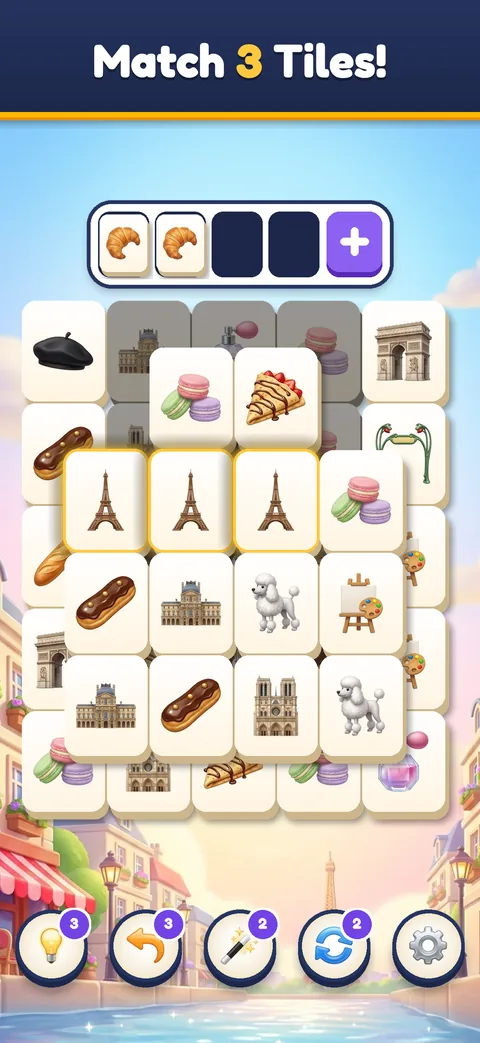
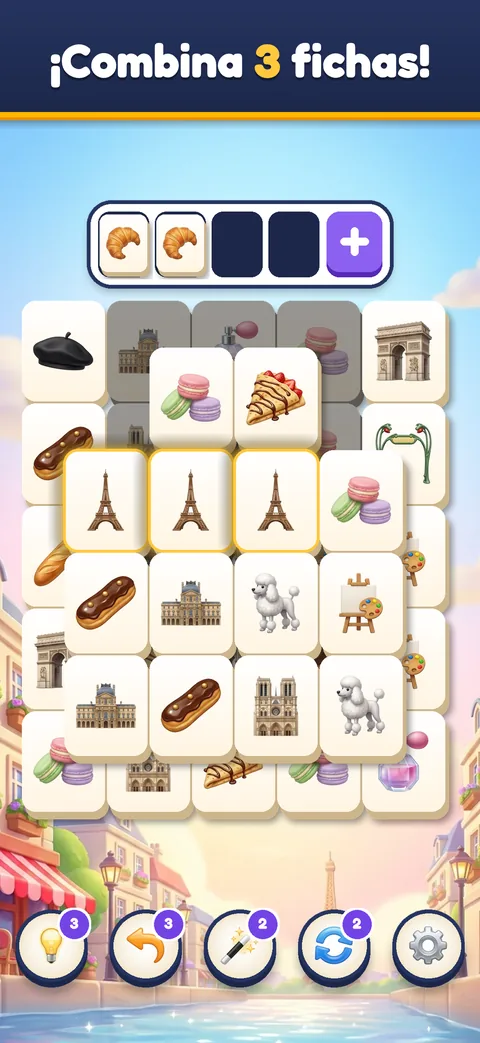
"Mahjong tile match" is what many players call the newer triple tile match style, because the board looks a lot like a mahjong layout: pictures on tiles, stacked in overlapping layers. The rules, though, are different:"Mahjong tile match" es como mucha gente llama al estilo más nuevo de triple tile match, porque el tablero se parece bastante a una disposición de mahjong: dibujos en fichas, apiladas en capas que se superponen. Las reglas, en cambio, son otras:
- You tap one tile at a time, and it moves off the board into a tray.Tocás una ficha por vez, y sale del tablero hacia una bandeja.
- When three identical tiles are in the tray, they clear.Cuando hay tres fichas iguales en la bandeja, desaparecen.
- You can usually pick any tile that is not covered by another one; there is no left-or-right rule.Por lo general podés levantar cualquier ficha que no esté tapada por otra; no existe la regla del lado izquierdo o derecho.
- If the tray fills up without a match, the level is lost.Si la bandeja se llena sin formar un trío, el nivel se pierde.
If you are new to the genre, our guide to triple tile match rules walks through a first board step by step.Si recién empezás con el género, nuestra guía de reglas del triple tile match recorre un primer tablero paso a paso.
Mahjong solitaire vs. tile match: the key differencesMahjong solitario vs. tile match: las diferencias clave
- Pairs vs. triples. Mahjong solitaire clears two tiles per move. Tile match needs three, so you often hold one or two tiles while you look for the rest.Pares vs. tríos. El mahjong solitario saca dos fichas por jugada. El tile match necesita tres, así que muchas veces guardás una o dos mientras buscás las que faltan.
- Free tiles vs. uncovered tiles. In mahjong solitaire a tile also needs an open long side. In tile match, being uncovered is usually enough, so more tiles are playable at once.Fichas libres vs. fichas destapadas. En el mahjong solitario una ficha además necesita un lado largo despejado. En el tile match, con que no esté tapada suele alcanzar, así que hay más fichas jugables a la vez.
- No tray vs. a tray. Mahjong solitaire has no holding area: a pair comes off together or not at all. In tile match, the tray is your limited memory, and managing it is the heart of the strategy.Sin bandeja vs. con bandeja. El mahjong solitario no tiene dónde guardar fichas: un par sale entero o no sale. En el tile match, la bandeja es tu espacio limitado, y manejarla es el corazón de la estrategia.
- How you get stuck. In mahjong solitaire you run out of free pairs. In tile match you fill the tray with tiles that cannot complete a set.Cómo te trabás. En el mahjong solitario te quedás sin pares libres. En el tile match llenás la bandeja con fichas que no llegan a formar un trío.
- The tiles themselves. Mahjong solitaire uses Chinese suits, winds and dragons, which take a little learning. Tile match games usually use everyday pictures you recognize instantly.Las fichas en sí. El mahjong solitario usa palos chinos, vientos y dragones, que cuesta un poco aprender. Los tile match suelen usar dibujos cotidianos que reconocés al instante.
Why fans of mahjong style games feel at home in tile matchPor qué a los fans de los juegos estilo mahjong les resulta familiar el tile match
If you love mahjong style games, most of your instincts carry over. You already scan layered boards, notice which tiles are trapped under others and think about what each move uncovers. In mahjong solitaire, you learn not to take a pair if it buries the other two copies; in tile match, you learn not to take a tile if it fills the tray without getting you closer to a set. Same idea, different pressure.Si te gustan los juegos estilo mahjong, la mayoría de tus reflejos te sirven. Ya estás acostumbrado a mirar tableros con capas, a notar qué fichas quedaron atrapadas debajo de otras y a pensar qué destapa cada jugada. En el mahjong solitario aprendés a no sacar un par si entierra las otras dos copias; en el tile match aprendés a no levantar una ficha si llena la bandeja sin acercarte a un trío. Misma idea, otra presión.
The main adjustment is the tray. A few habits make the switch easier:El ajuste principal es la bandeja. Algunas costumbres hacen más fácil el cambio:
- Before tapping, count how many copies of a tile you can reach right now.Antes de tocar, contá cuántas copias de una ficha podés alcanzar ahora mismo.
- Prefer finishing a set already in the tray over starting a new one.Preferí terminar un trío que ya está en la bandeja antes que empezar uno nuevo.
- Use early moves to uncover the layers, just as you would open up a blocked row in mahjong solitaire.Usá las primeras jugadas para destapar capas, igual que abrirías una fila bloqueada en el mahjong solitario.
For more on this, see how to beat hard tile match levels.Para profundizar, mirá cómo pasar niveles difíciles de tile match.
How to do it in Trip SortCómo hacerlo en Trip Sort
- Download Trip Sort: Triple Tile Match for free on iPhone or Android and open it. No account or sign-up is needed.Descargá Trip Sort: Triple Tile Match gratis en iPhone o Android y abrilo. No hace falta cuenta ni registro.
- Tap any tile that is not covered by another tile. It moves into the tray, which has 4 slots.Tocá cualquier ficha que no esté tapada por otra. Pasa a la bandeja, que tiene 4 casilleros.
- Collect three identical tiles in the tray to clear them, and clear every tile to finish the level. If the tray fills with no match, you can continue or retry.Juntá tres fichas iguales en la bandeja para que desaparezcan, y limpiá todas las fichas para terminar el nivel. Si la bandeja se llena sin trío, podés continuar o reintentar.
- Read the layers like a mahjong layout: later boards stack tiles in layers and ask you to think a few moves ahead. There are no timers.Leé las capas como en una disposición de mahjong: los tableros más avanzados apilan fichas en capas y te piden pensar unas jugadas por adelantado. No hay reloj.
- Need more room to plan? The Extra Slot booster adds a fifth slot to the tray, and Shuffle mixes up the tiles left on the board.¿Necesitás más lugar para planificar? El booster de casilla extra suma un quinto casillero a la bandeja, y el de mezclar reordena las fichas que quedan en el tablero.
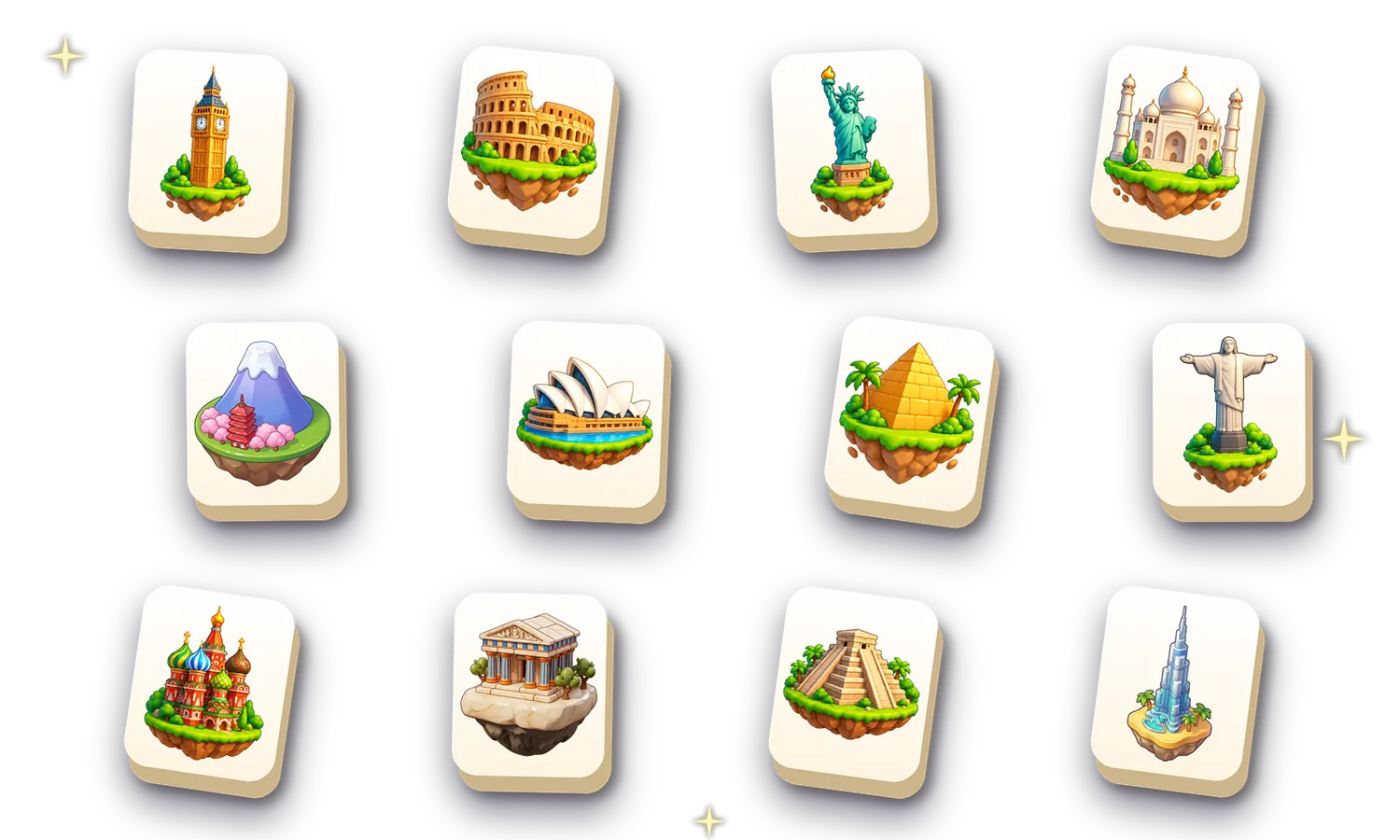
- Enjoy the pictures: instead of suits and dragons, each city has its own tiles, like torii gates and sushi in Kyoto or tango shoes and mate in Buenos Aires.Disfrutá los dibujos: en vez de palos y dragones, cada ciudad tiene sus propias fichas, como toriis y sushi en Kioto o zapatos de tango y mate en Buenos Aires.
Questions people also askLo que también preguntan
Is tile match the same as mahjong?¿El tile match es lo mismo que el mahjong?
No. Traditional mahjong is a four-player game with its own scoring. Mahjong solitaire uses the same tiles to remove pairs of free tiles from a layout. Tile match borrows the layered look but clears tiles in sets of three through a small tray.No. El mahjong tradicional es un juego de cuatro jugadores con su propio puntaje. El mahjong solitario usa las mismas fichas para sacar pares de fichas libres de una disposición. El tile match toma el aspecto en capas, pero las fichas desaparecen de a tres a través de una bandeja chica.
What makes a tile free in mahjong solitaire?¿Qué hace que una ficha esté libre en el mahjong solitario?
A tile is free when no other tile sits on top of it and at least one of its long sides, left or right, is not touching another tile. Only free tiles can be matched and removed.Una ficha está libre cuando no tiene ninguna otra encima y al menos uno de sus lados largos, el izquierdo o el derecho, no toca otra ficha. Solo las fichas libres se pueden emparejar y sacar.
Is tile match easier than mahjong solitaire?¿El tile match es más fácil que el mahjong solitario?
It is easier to learn, because the pictures are familiar and the only rule is to collect three of a kind. It is not always easier to win: the small tray means a few careless taps can end a level, so planning matters just as much.Es más fácil de aprender, porque los dibujos son conocidos y la única regla es juntar tres iguales. No siempre es más fácil de ganar: la bandeja chica hace que unos pocos toques descuidados terminen un nivel, así que planificar importa igual.
Keep readingSeguir leyendo

Relaxing Zen Puzzle Games to Unwind After a Long DayJuegos de puzzle zen y relajantes para desconectar al final del día
Read the guide →Leer la guía →
A Travel Puzzle Game: Visit 255 Destinations From Your PhoneUn juego de puzzle de viajes: visitá 255 destinos desde tu teléfono
Read the guide →Leer la guía →